Florida Senate Bill 180 (2025) (“SB 180”) was recently signed into law. SB 180 created several new laws and regulations regarding declared States of Emergency and Florida real estate development. Specifically, SB 180 creates Florida Statute Sec. 252.422, which currently preempts all local Florida governments from creating new more restrictive land development regulations and taking other development hindering actions.
Impacted Local Governments and Prohibited Actions
SB 180 classifies counties listed in a federal disaster declaration, located wholly or partially within 100 miles of a hurricane's track, as "impacted local governments." This classification extends to all municipalities within those counties. Based on the FEMA registered disasters of Hurricane’s Milton and Helene, the entire state is an impacted area. See applicable maps below:
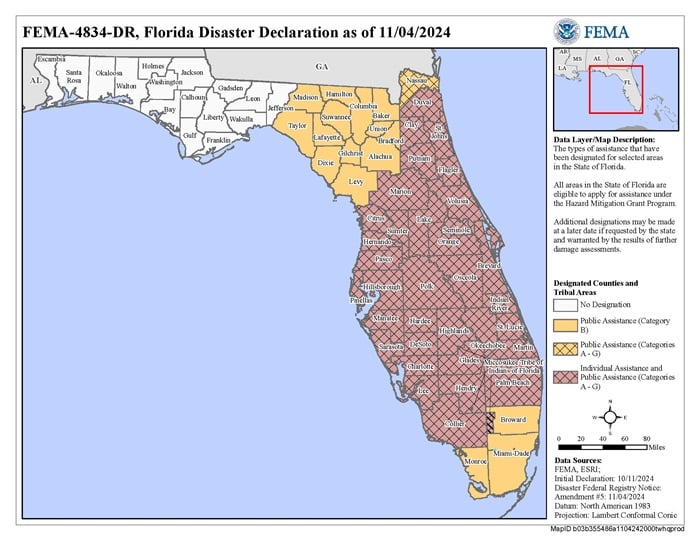
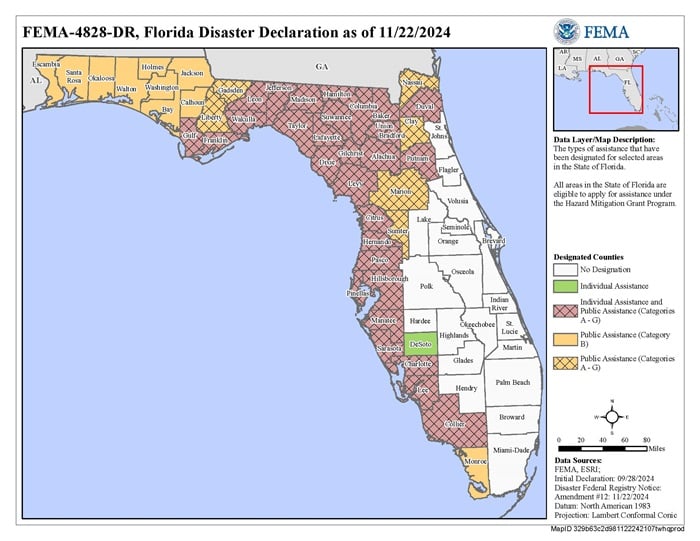
For one year following a hurricane's landfall, impacted local governments are prohibited from adopting:
- moratoriums on construction, reconstruction, or redevelopment;
- more restrictive amendments to comprehensive plans or land development regulations; and,
- more burdensome procedures for site plan reviews, development permits, or development orders.
Legal Recourse and Advisory Opinions
SB 180 also allows for any individual to file suit for declaratory and injunctive relief against an impacted local government to enforce SB 180. Before filing, plaintiffs are required to provide notice to the local government, setting forth the facts upon which their complaint is based and the reasons why the local government’s action violates the law. Upon receipt of the notice, the local government will have 14 days to void the action. If the action is not voided within 14 days, the plaintiff will be entitled to a preliminary injunction that prevents the implementation of the challenged government action until the plaintiff’s claim is ruled on by the court. All plaintiffs who prevail in their suit will be entitled to recover attorney fees and costs from the local government.
Any impacted local government may request a judicial determination regarding whether a proposed action violates any section of Florida Statute 252.422. Upon request for such a determination, the impacted local government will be prohibited from enforcing the action until the court issues a preliminary or final judgment.
OPPAGA Study
The statute directs the Office of Program Policy Analysis and Government Accountability (OPPAGA) to study local government actions enacted after a hurricane, and related to comprehensive plans, land development regulations, and approval procedures. As part of this directive, OPPAGA will survey local stakeholders to assess the impact of the new regulations and recommend further legislative measures for the state legislature to consider in order to remove future impediments to development after a hurricane. This provision applies to all local governments, not just those classified as "impacted".
Exceptions
Certain restrictions approved within this period may be enforceable if: (a) the associated application is initiated by a private party who owns the property that is subject to the restriction; (b) a comprehensive plan amendment was submitted to reviewing agencies before landfall; or, (c) the comprehensive plan amendment or land development regulation is approved by the state land planning agency.
SB 180 and Florida Senate Bill 1730 (2025) (“SB 1730” or “Live Local Act 2025”)
SB 1730 created several important updates to the Live Local Act. Many of these updates created clarifying definitions to create more consistent application of the law. Notwithstanding, since the adoption of the Live Local Act in 2023 in Florida Senate Bill 102 (“SB 102”), development regulations have been adopted that inadvertently have created some challenges for the Live Local Act. While SB 1730 clearly states that the height, density and intensity permitted by Live Local are the maximums permitted as of the date of the adoption of SB 102, the new SB 180 can be used to void other more restrictive land development regulations not explicitly covered by the preemption created in SB 102.
Should you have additional questions, please feel free to contact us or visit our Live Local Act resource page at www.bilzin.com/livelocal.
